 |
| Periods of renewal for our Time Lord icon are explored and celebrated in the new BBC DVD set: REGENERATION. All images: BBC. |
DOCTOR WHO: REGENERATION (DVD BOXSET)
Starring William Hartnell, Patrick Troughton, Jon Pertwee, Tom Baker, Peter Davison, Colin Baker, Sylvester McCoy, Paul McGann, Christopher Eccleston, David Tennant and Matt Smith as the Doctor
Now available from BBC DVD
Reviewed by Scott Weller
With current TARDIS incumbent Matt Smith getting ready to hand in his fez and pass on his sonic screwdriver as DOCTOR WHO to an all-new actor, for an all-new generation of families to enjoy, BBC DVD, celebrating the show’s fiftieth anniversary, and reminding us that the show has successfully had ten previous actors in the title role in the lead-up to the Eleventh’s surely spectacular finale, presents a lovely and timely new DVD box set (with lavish info-packed accompanying book)- REGENERATION- reminding us all why the show is so unique and just how revolutionary, and handy, the idea of bodily regeneration would be for the series and its iconography- an inspired, if at first seemingly desperate, behind the scenes measure turned culturally significant event, that started way back in 1966…

Come with us as we explore and review these always sad but magical times in the shows past…
 |
| Emerging from the snow, the Cybermen make their first appearance in The Tenth Planet. |
THE TENTH PLANET (William Hartnell - 1966)
The emergence of Earth’s long-lost twin planet Mondas and the arrival of strange inhuman beings at an isolated arctic base become part of the catalyst for the first iconic regeneration of the original incarnation of the heroic wanderer in time and space, the Doctor (an overall kindly, yet authoritative, often crotchety, performance from the iconic William Hartnell), in the enjoyable conclusion to his three-year reign: THE TENTH PLANET.
Soon becoming second in rank to those gliding metal abominations, the Daleks, as the Doctor’s most enduring and dangerous enemies, these early Cybermen may not be as visually pleasing in this introduction tale as they would be in later incarnations, but their chilling potential, devised by series script editor Gerry Davis and writing partner, scientist Kit Pedler, soon becomes apparent. With creepy human hands, their faces and bodies wrapped tight in medical stockings, alongside cruelly inhuman eyes sticking out, and unusual and unfeeling computer controlled tone voices, their first appearance, planning to absorb the Earth and their cousins of humanity in order to stop their planet’s impending disaster, is a memorable one.
 |
| The Doctor (William Hartnell) and Polly (Anneke Wills) confront the Cybermen. |
Sadly, despite one major, verbal confrontation with the creatures, William Hartnell’s Doctor is not the head of the party in their ultimate, overall satisfying defeat. Unwell throughout this and the other stories of his final seasons, and in constant conflict with his era’s then producers, the lead star’s forced departure from the series is truly the end of an era, but feels tacked on to the overall alien invasion/base under siege story that would become so commonplace in later WHO stories, with no real reason given for his “rejuvenation” other than his telling companions, sea-faring Navy boy Ben (Michael Craze) and genuine sixties dollybird Polly (Anneke Wills), that his old body is now “wearing a bit thin.”
 |
| The incredible first regeneration of William Hartnell into Patrick Troughton. |
Still, that classic scene, a first for the series, and the key to its overall longevity for the next fifty years, proves a simple but effective handover to the younger, but just as experienced, character actor Patrick Troughton, the soon “Cosmic Hobo” of the series, and its next custodian, for the following monster-packed three years.
Note: Presented on the disc are the original surviving three episodes of the story. The fourth and final one, sadly missing from the BBC Archives bar a few surviving film clips (including the all-important regeneration, survived through the good fortune of having appeared on a seventies episode of the children’s magazine programme BLUE PETER!), is represented in impressive, full animation form from the BBC, in conjunction with the Planet 55 studio, alongside the surviving off-air soundtrack recording. It’s a triumphant restoration.
 |
| The First Doctor collapses, ready to regenerate in the story's closing moments, brought back to life in animated form for the new release. |
Animated clips:
 |
| Time chaos for the Second Doctor in The War Games. |
THE WAR GAMES (Patrick Troughton - 1969)
Believing they’ve arrived in the sodden, battle intense trenches of Earth’s Great War, the Second Doctor, with his companions heroic highlander Jamie McCrimmon (Frazer Hines) and super-intelligent Zoe Heriot (perky Wendy Padbury), instead find themselves caught in an alien war games experiment, with peoples and eras from the planet’s most savage periods of history deliberately put in continuous combat scenarios, assembled for a planned attack on the galaxy by the alien War Lord and his legions.
Recently joined series writer Terrance Dicks and buddy Malcolm Hulke deliver an epic story concluding the shows atmospheric black and white era (and handily filling a huge behind the scenes hole on two adventures that had fallen through due to production problems), combining history and action runaround science fiction in an exciting package, plus an intriguing new alien menace in the shape of the War Lord, a coolly evil presence from Philip Madoc, with his ambitious scientist cohort, the War Chief (Edward Brayshaw), who is also discovered to be an exile from the Doctor’s own race…
 |
| In the trenches, the Second Doctor (Patrick Troughton), with Jamie (Frazer Hines) and Zoe (Wendy Padbury). |
Director David Maloney keeps things zipping along and the only hint of story padding to the ten-parter is felt around episodes five and six, though the introduction of the shows principal alien villains a short time after quickly propels the adventure to an exciting and memorable conclusion, and a fitting end for Troughton, giving us a glimpse of the characters past history, and the huge powers and responsibilities of the series early incarnation of the Time Lords (of the later Jon Pertwee era named Gallifrey).
 |
| His regeneration exile begins... |
Having limited resources to contain the situation, the Doctor eventually has no choice but to call in help from his people to imprison these very dangerous adversaries, but the price will be his fugitive freedom to travel in space and time, punished into exile to his favourite planet, with vital knowledge of the TARDIS removed, along with a new regenerated persona…
 |
| Behind you! The Third Doctor (Jon Pertwee) confronts a controlled Sarah (Elisabeth Sladen) and one of the Planet of the Spiders. |
PLANET OF THE SPIDERS (Jon Pertwee - 1974)
The evolutionary enhanced spiders of the Metebelis Three planet, led by the fearsome Great One, are desperate to recover the power of their “stolen” Great Crystal, now residing in the Third Doctor’s borrowed hands on Earth. Soon arriving on our planet, they use a corrupted, bitter human, Lupton (John Dearth) to capture it, in a conflict that takes the Time Lord and his loyal companion, Sarah Jane Smith (Elisabeth Sladen) to their alien stronghold for a final confrontation…
 |
| Confronting the Great One on Metebelis Three. |
 |
| "Tears, Sarah Jane?" The Third Doctor begins his transformation. |
Facing his fears against the terrifying powers of the hysterically evil alien spider, The Great One (some nice practical effects work for their time from Ian Scoones and Matt Irvine), action hero WHO incarnation Jon Pertwee bows out in true JAMES BOND-esque style in the shows early episodes (his use of gadgets and technology, mirrored by the actors love for them in real life, effectively used for one last big chase episode), but its his serious character acting side that shines the brightest in the story’s final episode, saving the universe in style as the Doctor shows his personal, inner courage- actions that will soon send his radiation poisoned body into a new, more Bohemian, regeneration.
 |
| Our iconic hero is once more forced into an alliance with the psychotic Master (Anthony Ainley) in Logopolis. |
LOGOPOLIS (Tom Baker - 1981)
Big scarfed, bigger- than-life Tom Baker’s incarnation of the Time Lord, the most popular incarnation of the role during its classic years, is at his doom-laden best here. All he wants to do is repair the TARDIS and its shape changing chameleon circuit, with the help of friendly mathematical aliens the Logopolitans, but his vengeance fuelled rival, the evil Master (now in a newly regenerated form, played in a sneerily insane, not yet camp way by Anthony Ainley) will stop at nothing to destroy him, whilst also using Logopolis’s mathematics over matter abilities to control the universe.
Abandoning the previous seasons often over reliance on humour, scientific journalist and then current script editor Christopher H. Bidmead provides an intriguing, sometimes chilling, sci-fi concept linked to the entropy factor, whilst also brilliantly building towards the story’s last-rites atmosphere/flavour (helped by Peter Grimwade’s efficient direction) for Baker’s anticipated, but fan dreaded, end of seven year dominance regeneration into the series new promising lead star Peter Davison (who soon takes the series firmly into the eighties like a breath of fresh air, alongside three equally young companions in the TARDIS). The introduction of the eerie and unusual third party to this finale- the mysterious “Watcher” - proves an intriguing series development leading in to that all-important changeover.
 |
| Time has run out for the Fourth Doctor. |
 |
| A new Doctor for a new era. |
“It’s the end, but the moment has been prepared for…”
 |
| A hero to the end. The Fifth Doctor (Peter Davison) rescues Peri (Nicola Bryant) in The Caves of Androzani. |
THE CAVES OF ANDROZANI (Peter Davison - 1984)
On the far distant, future world of Androzani Major, the Spectrox chemical is the most desirable and expensive substance in the universe- an ultra-efficient OIL OF ULAY that can increase humanity’s lifespan. Worth its weight in gold, men (and women) will kill to capitalize on and control its use.
But in its unrefined state its also a killer, as the heroic and vulnerable Fifth Doctor and his spirited American sidekick Peri (Nicola Bryant, in her finest performance in the series) soon discover to their peril in THE CAVES OF ANDROZANI, a story that years later still lives up to its distinguished and acclaimed moniker from fans as the original series all-time classic.
 |
| The Doctor and Peri meet Sharaz Jek. |
A true and tragic victim of fate and circumstances, Peter Davison’s energetic, kindly cricket-loving, celery stick lapel wearing Fifth Doctor is caught in a war between the Androzani system’s politically controlled army, ruthless gun runners and a revenge fuelled madman and his robot duplicates, hiding and fighting in the Spectrox thriving caves of Androzani Minor.
Playing the role for an all-too brief three years, the Fifth Doctor bows out with the noblest and bravest death of all the Time Lord’s incarnations, ultimately sacrificing his life not to save the universe, but his friend and companion, retrieving the last vestiges of antidote against overwhelming odds and an on-the-brink-of-collapse state of health. The story is not only Davison’s accomplished swansong, its also his strongest series performance, working from a brilliant script delivered by returning and remarkable series talent Robert Holmes, efficiently directed with zest and vigour by then newcomer Graeme Harper, who grabs hold of the material with both hands and doesn’t let go of it, breaking the bounds of what could be accomplished at the time in the BBC studios, bringing enthusiasm and dedication to the series whilst amping up a stellar cast (including John Normington as the duplicitous conglomerate boss Trau Morgus, and dancer/actor Christopher Gable in a towering, award-worthy performance as the brilliant but deranged, facially damaged scientist Sharaz Jek).
 |
| The dangerous but tragic figure of Sharaz Jek (Christopher Gable). |
CAVES OF ANDROZANI is a triumph in every aspect- a passionate story of action, horror and tragedy that totally transcends its limited budgetary resources, and whose sterling reputation-the jewel in producer John Nathan-Turner’s crown- remains undiminished, soon proving hard to match or equal in the shows subsequent classic years of story telling.
 |
| "Feels different this time." The Doctor begins to regenerate. |
 |
| "Change, my dear..." A zestful Colin Baker arrives on the series. |
With the series finest visually realized regeneration blazing onto the screen, Colin Baker’s curly haired, at first seemingly unstable and fiery, yet dedicated, portrayal of the Sixth Doctor is soon leaping into action, though his presence, in a tasteless conceived multi-patchwork outfit, soon proves controversial with fans, audiences and incoming, snobby BBC management…
 |
| Strange matters for the new Seventh Doctor (Sylvester McCoy) in Time and the Rani. |
TIME AND THE RANI (Sylvester McCoy’s entrance and the Sixth Doctors exit - 1987)
Unfairly axed from the series by a threat to the Doctor’s existence far greater than anything he had previously faced in his then twenty-three year TV reign- the determined to exterminate the series veneer of the smug and unimaginatively plodding BBC chief Michael Grade (at the time seen as a savior of the corporation, but with an axe to grind against the long-running series and its star), Colin Baker’s big-brained, big-egoed Sixth persona never had the chance to truly emerge from the starting gate with audiences, his seven-year plan to slowly show us more facets to the role abandoned to the vagaries of the land called What if?
 |
| A wigged Sylvester McCoy gets ready to film the Sixth Doctor's hasty regeneration. |
Angry and emotionally bruised by his sacking after only two years on screen, Baker quite rightly refused the BBC’s offer to come back for a final four-part tale the following season, that would see him blown up by its conclusion and regenerating into the soon chosen visage of comedian/actor/stage talent Sylvester McCoy, bringing his own unique Scottish brogue to bear, along with a touch of Troughton flavoured comedy and some later darkness, to his Seventh incarnation.Instead, the story would be hastily re-shaped and McCoy, courtesy of a blonde curly wig, would play both the Sixth and newly regenerated Seventh Doctor in the opening moments of TIME AND THE RANI, launching the series twenty-fourth season in colourful calamity in 1987, the series-changing incident caused by a head injury sustained inside the TARDIS, after the time/space vehicle is ripped out from the vortex by the machinations of his old nemesis, the unscrupulous and immoral The Rani (played by the striking and sexy Kate O’Mara, fresh from American success in the series DYNASTY).
In a story with some strong ideas at their core (including a mysterious asteroid made from Strange Matter (a very real scientific phenomenon being studied today), plus the introduction of an excellent race of bat-like creatures, the Tetraps), the overall visual style of the story and solid direction from series newcomer Andrew Morgan shines the greatest- the shows then reduced episode count, from twenty-six to fourteen, giving the show more necessary funds to utilize.
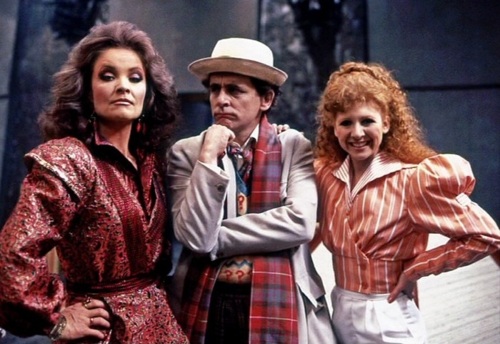 |
| Stuck in the middle. The new Seventh Doctor with the Rani (Kate O'Mara) and Mel (Bonnie Langford). |
Newcomer McCoy shows promise in early and later scenes within fan-controversial Pip and Jane Baker’s story, though the idea of the Rani impersonating his at-large and in danger companion Melanie (Bonnie Langford- the genuine Scream Queen of the series), in order to get the at-first amnesiac Doctor to work for her on her universe dominating bio-technology, strains credibility, not quite stretching to the opening two episodes.
Very much a child of 1987 (right down to the overloaded synthesizer incidental score by Keff McCulloch), and much derided at the time of transmission, TIME AND THE RANI has often been seen by a great many as the true beginning of the end for the classic series, but ultimately it isn’t as bad a beginning to the three-year McCoy era as many would have you believe, proving perfectly watchable stuff for the most part…
 |
| A lively Eighth Doctor (Paul McGann) and Dr. Grace Holloway (Daphne Ashbrook). |
DOCTOR WHO: THE MOVIE (Paul McGann – 1996)
Colin Baker may have been treated badly as the Doctor off-screen by Auntie Beeb and its WHO hating elite cadre located at the Top Floors of Shepherd’s Bush TV Centre, but their treatment of the on-screen Seventh persona of Sylvester McCoy would prove far worse and totally cruel with his guest appearance in the shows popular, though then sadly one-off return in 1996- emerging from the TARDIS on the eve of Earth’s Millennium, forced into landing in San Francisco by the gooey form of a body destroyed The Master (at first well played by Eric Roberts , but later straying too far into camp mode), our no longer paisley tied hero is brutally gunned down by a group of Chinese gangsters, then accidently killed off through mistakes made by human doctors trying to save his life on the operating table. Thus the scene is set for McCoy’s by now happy-go-lucky character to regenerate in to the mercurial but no less heroic Paul McGann, a great Doctor whose later potential would thankfully be shown in the vast range of official BIG FINISH audio dramas, wearing an acquired fancy dress party outfit homage to America’s Buffalo Bill, as he and new companion, Dr. Grace Holloway (a spunky performance from Daphne Ashbrook, who would have made a great regular series companion had it continued), rush to save the now humanoid Master from destroying Earth and stealing the TARDIS.
This co-production between the BBC and FOX/UNIVERSAL could have been a disaster, but the film works for its first two acts (introducing elements that later 2005 onwards series writers and producers would expand on) until a messy ending that, at the time, was the best that could be thought up to satisfy all interested parties/backers. A big hit in the UK, it’s distinctiveness British-ness, on a bigger budget than ever before and made throughout on film, failed to capture a mass US audience, which was then more interested in crappy video-taped comedy like ROSEANNE!
A fresh start to the series, like the one later given by Russell T. Davies to the rebooted WHO series starring Christopher Eccleston, would likely have been the best thing to start the series afresh in 1996 to overall worldwide viewers, but veteran Hollywood producer and die-hard series fan Philip Segal was determined that McCoy would have some closure to his era, of which WHOvians enjoyed the kind of passing of the torch scene setting that had been so sadly lacking with Colin Baker’s exit.
 |
| A splendid Christopher Eccleston departs the TARDIS in Parting of the Ways... |
BAD WOLF/PARTING OF THE WAYS (Christopher Eccleston – 2005)
Returning like a phoenix from the flames, DOCTOR WHO’s 2005 “re-birth” couldn’t have gotten off to a better start with the general public than having acclaimed and respected character actor Christopher Eccleston in the title role-playing a more serious, battle hardened, battle weary loner who finds himself and his purpose in the universe thanks to the help of his companion, Rose Tyler (Billie Piper, easily one of the new series brightest young stars). So it’s a shame that his reign of the new organic-looking TARDIS control room was all so brief-just one season. We’ll never know for sure if this short term was truly to have been the case-some media reports say that Eccleston was always only going to do one year on the show, to get it going again –a stipulation of his appearing made to its creative controller, Russell T. Davies, and that his departure would be planned as a big surprise to viewers. But others say not, and that he ultimately left through unhappiness with the attitudes, ill-manners and overall culture of the series behind the scenes making.
 |
| The Daleks are back! |
Still, despite the various rumours, bargains and lies, he couldn’t have had a better story to exit the series with than this two-parter, which deftly shows Russell T. Davies’s skills as a story teller and the way he’s able to shift an at first seemingly lightweight story (the Doctor and co. trapped on a timeline-altered future space station that deals in entertainment programming gone very bad-Big Brother and The Weakest Link- where there’s no prize, or life, for coming in second place!)- into a big and epic, often gloomy, action-packed base under siege epic. And then, of course, there’s the Daleks, effectively used in part two once their presence behind the station is teasingly revealed, their race previously thought wiped out forever off-screen by Eccleston’s Doctor (during the now often mentioned Time War) but now a living, terrifying, Exterminating reality in their thousands (we all deep down knew that we’d finally see a Dalek army- after a singular appearance by one of the pepperpot terrors earlier in the season, trapped on Earth in Robert Shearman’s justly well received story, Dalek).
 |
| Rose Tyler (Billie Piper) - prisoner of the Daleks! |
His faithful companion Rose now captured by them, our heroic Doctor delivers one of his finest, most captivating, inspiring and can’t wait to see what happens next speeches against his sworn enemies, promising his friend that he’ll rescue her and wipe out every last stinking Dalek off the face of the galaxy! Go got ‘em, Doc!
Ultimately playing all his trump cards, his invention and last minute resourcefulness, the overwhelmed Doctor succeeds thanks to the intervention of an equally determined Rose Tyler, her body dangerously touched by the powers of time travel and the TARDIS. But in the end, it takes his personal sacrifice, and a loving kiss, to secure her from annihilation, resulting in a new and explosively spectacular regeneration for our Northern speaking Time Lord.

 |
| The modern series first spectacular regeneration, as David Tennant makes his debut. |
His “goodbye message” to Rose earlier in part two had been eye-watering enough for viewers, but this final scene-his “Fantastic” final scene- was a wonderful sign-off to a brash, colourful, exciting, nostalgic, funny and sometimes scary season, which brought heart and soul back into the series and set the template for things to come. Thanks, Christopher!
 |
| One last battle at The End of Time, against the Master (John Simm), for the Doctor and Wilf (Bernard Cribbins). |
THE END OF TIME (David Tennant – 2009/2010)
So, how do you follow up the departure of Christopher Eccleston? Well, you get David Tennant! Easily, the modern series most popular incarnation (and the longest running so far), his legions of adoring fans would help further cement the popularity of the show for the next three years, as his personal charisma steers it a bigger, more ambitious phase, though perhaps a little bit too camp and comedic at times (especially with the arrival of Catherine Tate as ballsy but out of her depth companion Donna Noble), but nonetheless garnering high impact publicity and audience appreciation close to that of original series icon Tom Baker and his era.
 |
| "I don't want to go!" David Tennant bids adieu. |
 |
| "I'm a girl?" Matt Smith brings some fun to his regenerated form. |
But all things must come to an end, and an actor can’t be confined to one role for too long. Tennant’s swansong is the end of an era in many ways, not just with his departure, but also with the behind the scenes team that had worked on bringing the show back to TV airwaves since 2004. This final heavily Christmas themed two-part story from Russell T. Davies is very self-indulgent- concerning the re-born Master’s (a waayy over the top John Simm) attempts to repopulate the Earth is his own image, whilst the Doctor not only has to fight him/them but also the emerging time and space ripping presence of the restored, for one night only, Time Lords of Gallifrey. But fans loved it in their millions, especially the Doctor’s once more humanity and self-sacrifice for a companion-this time out Bernard Cribbins’ amiable old dodder, Wilf Mott. Beyond his sad death from radiation poisoning, the shows final twenty minutes for the Tenth Doctor gives us a tear-jerking goodbye from the dying hero to all his friends and loved ones (the farewell to Elisabeth Sladen’s character of Sarah Jane Smith now even more poignant with her sad passing in 2011), whilst his infamous “I don’t want to go” moment is truly affecting. Matt Smith’s lively, out of the shell appearance by story’s end promises an even more youthful and eccentric fresh start ahead...

Get hold of DOCTOR WHO: REGENERATION here: Doctor Who: Regeneration [DVD]: Amazon.co.uk: William Hartnell, Patrick Troughton, Jon Pertwee, Tom Baker, Peter Davison, Colin Baker, Sylvester McCoy, Paul McGann, Christopher Ecclestone, David Tennant, Matt Smith: Film & TV


